By Fedor Blaščák, Director of the Open Society Foundation Bratislava. This essay was originally published in Slovak in Denník N.
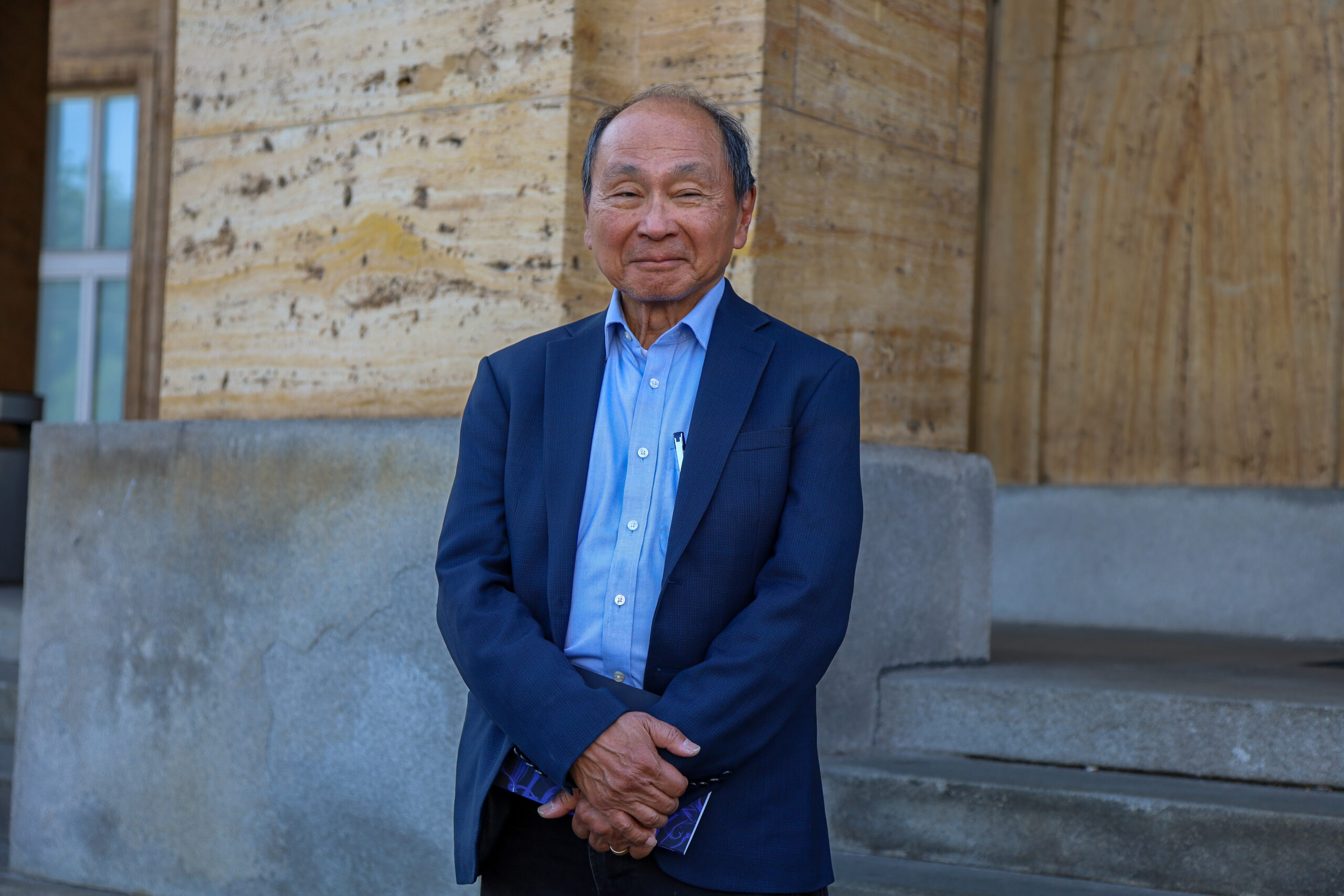
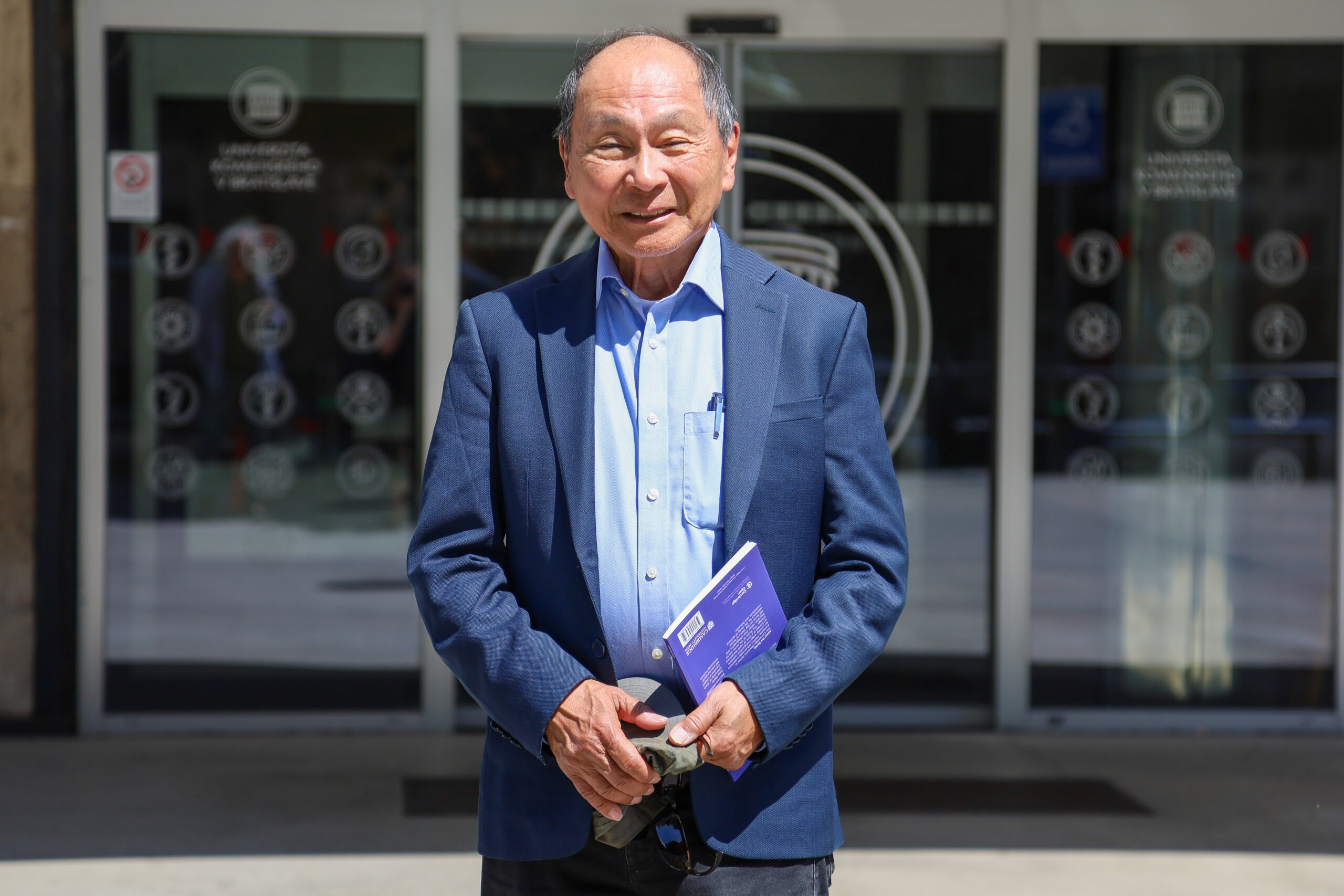
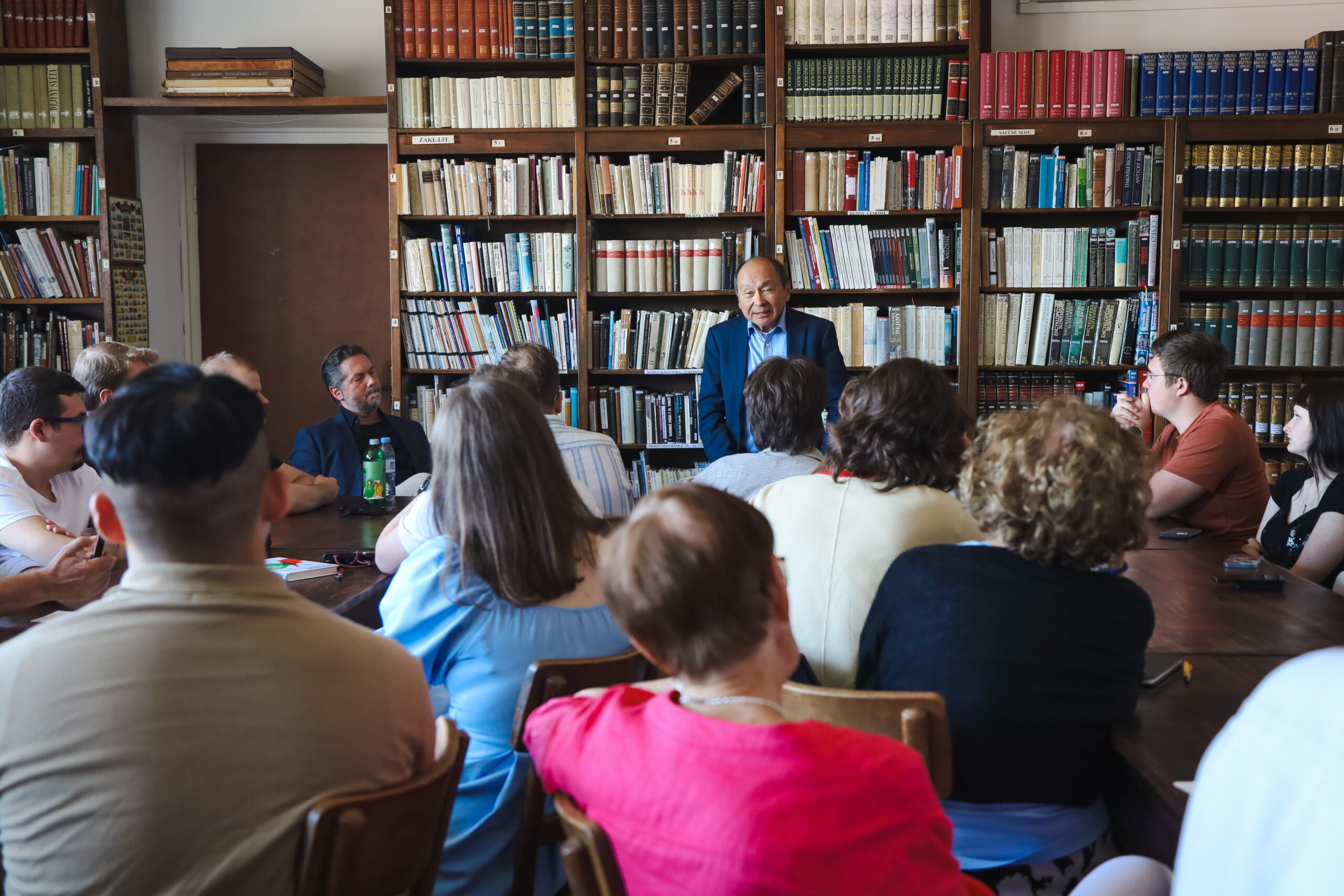
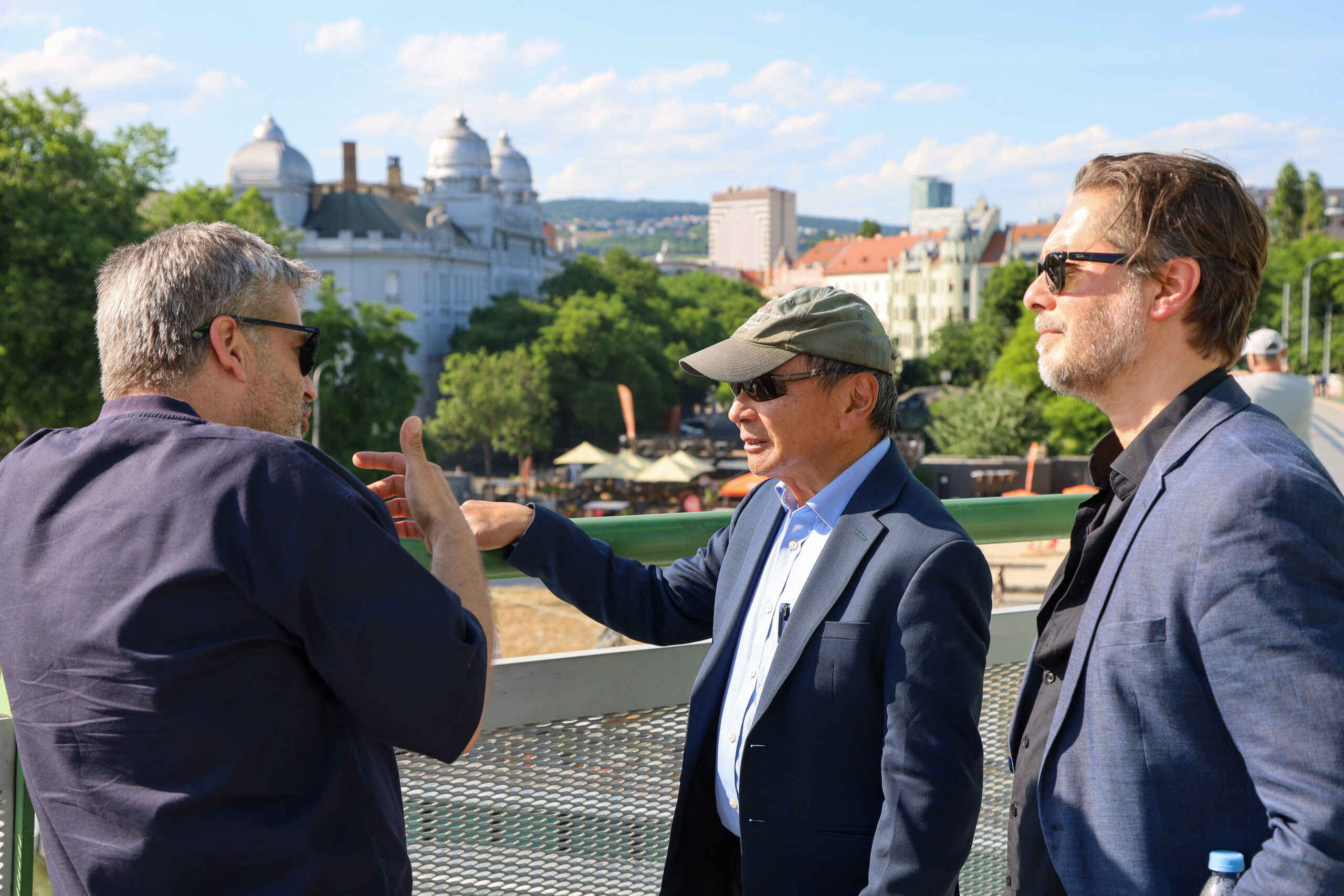
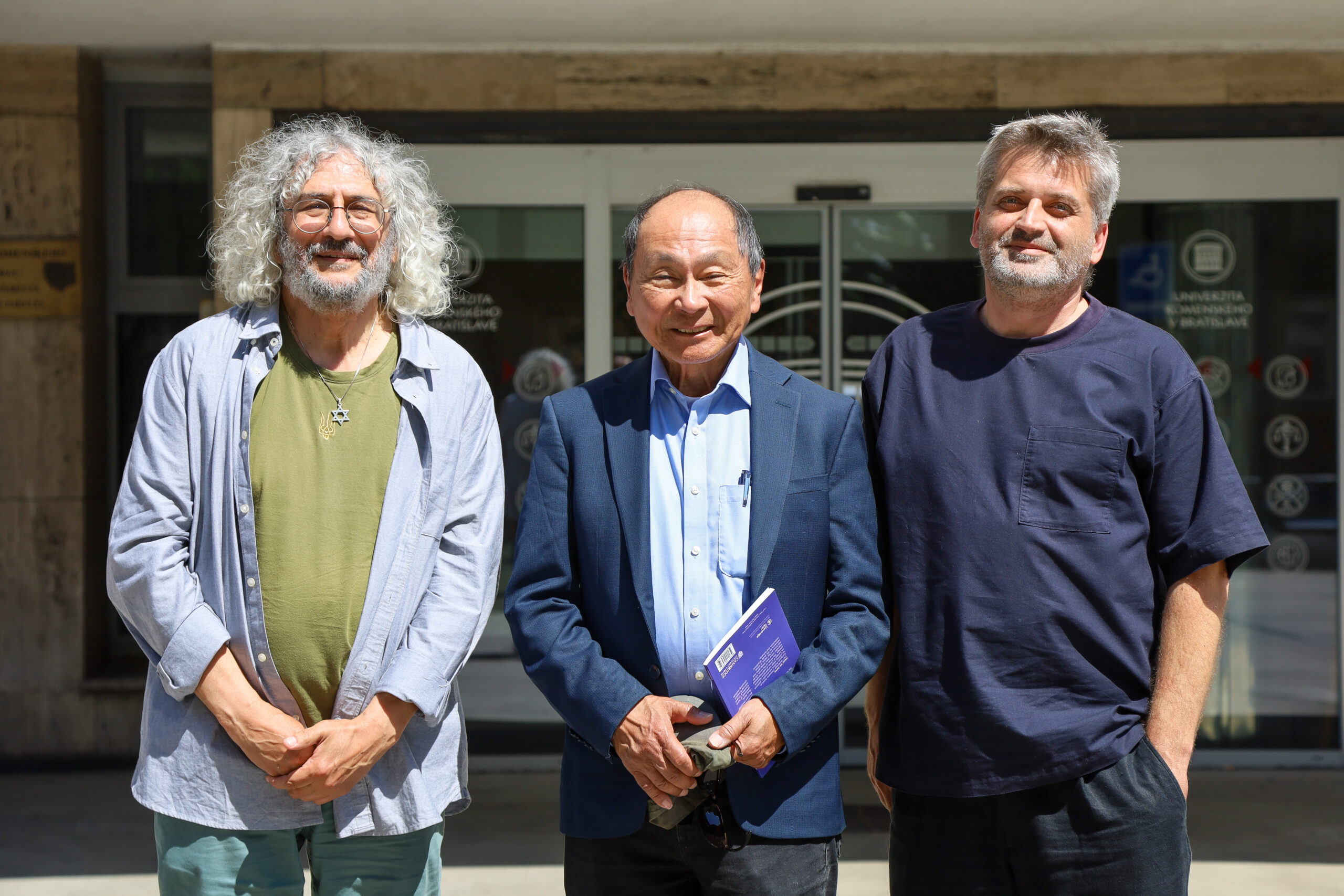
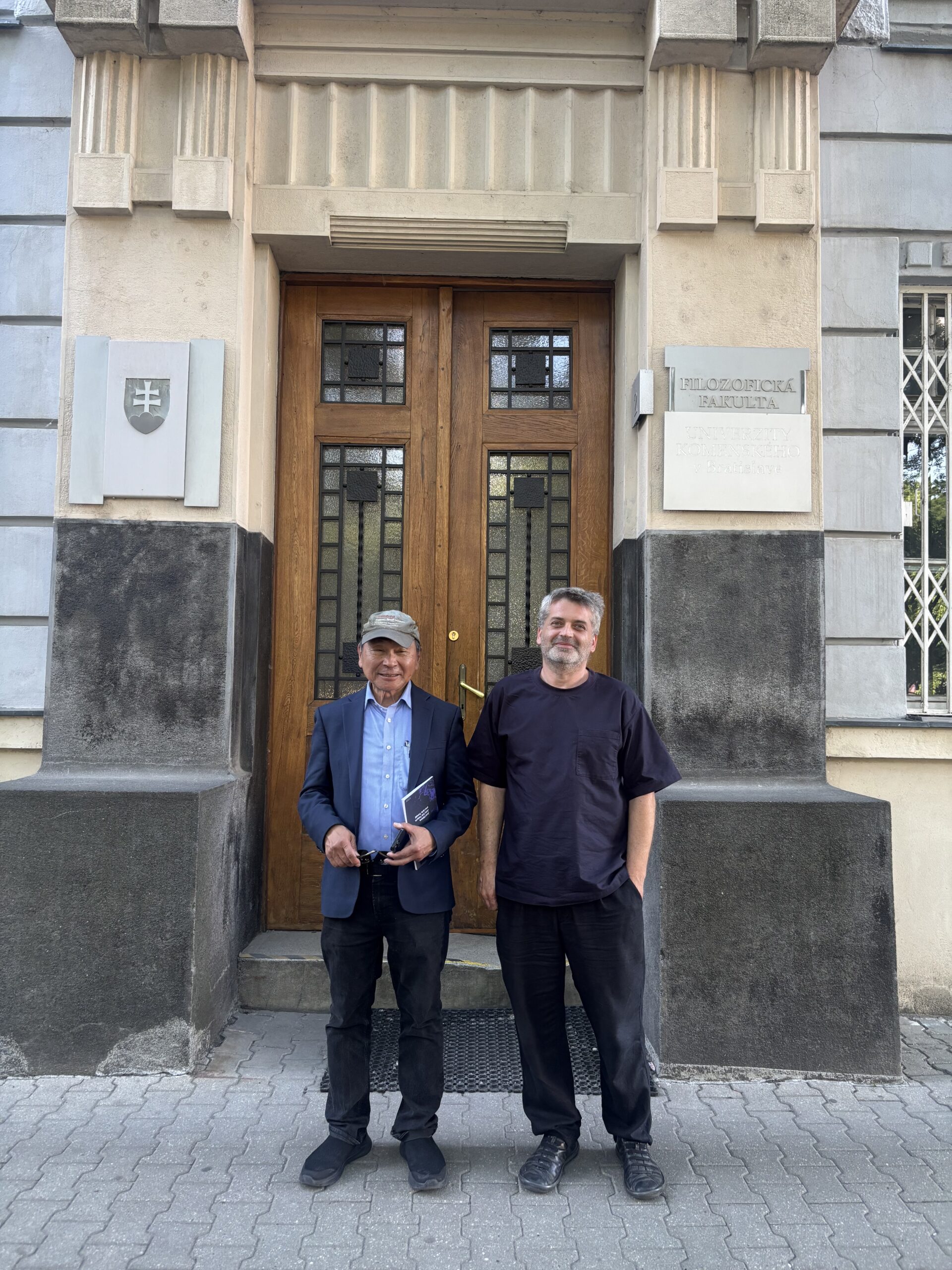
On 8 and 9 June, I had the privilege of accompanying one of the world’s most influential political thinkers, Francis Fukuyama, during his visit to Slovakia. He accepted an invitation from the Open Society Foundation Bratislava and the Institute for Public Affairs to deliver a lecture for students enrolled in the Liberal Democracy course at the Department of Political Science of Comenius University’s Faculty of Arts, and to meet with social scientists at an informal seminar.
Professor Fukuyama teaches at Stanford University and regularly publishes both academic scholarship and public commentary. With an h-index of 120 and more than 180,000 citations, he ranks among the world’s leading scholars across all fields of the social sciences.
What impressed me most was his humility, intellectual depth, and genuine curiosity. He was keenly interested in both Slovak history and contemporary politics. As one of the foremost experts on the end of the Cold War, he has a profound knowledge of Russia—he speaks Russian—as well as of the countries of Eastern Europe. Yet this was his very first visit to Slovakia.
Over the course of those two days, it was impossible to avoid discussing his famous thesis on the End of History. Although the question mark in the title of his original essay clearly indicates that Fukuyama presented it as a hypothesis, subsequent public discourse came to treat it as a definitive thesis. For that reason, I will approach it in the same way throughout this essay.
Freedom in 1989 Came from the Kremlin
One of the most influential essays of the twentieth century, Francis Fukuyama’s The End of History?, appeared in the Summer 1989 issue of The National Interest. At the time, its author was not affiliated with any of America’s elite universities, although he had aspired to an academic career. Instead, he served as Deputy Director of the Policy Planning Staff at the U.S. Department of State.
The timing could hardly have been better.
On the surface, everything in the Soviet bloc still seemed unchanged. Yet the old Stalinist order was being upheld only by an ageing generation of hard-line dictators in East Germany, Romania, Bulgaria, and Czechoslovakia—Honecker, Ceaușescu, Zhivkov, and Husák/Jakeš—who clung desperately to power.
Meanwhile, perestroika was reaching its peak in the Soviet Union. In March 1989, the country held its first semi-free elections, bringing the dissident Andrei Sakharov into parliament. That same summer, Poland was in the process of forming its first non-communist government after holding semi-free elections in June, in which the communists suffered a crushing defeat. In Hungary, tens of thousands of East Germans were waiting for the border with Austria to open—first symbolically on 19 August, and then fully on 10 September.
When Mikhail Gorbachev abandoned the ageing Stalinist regimes of Eastern Europe to their fate, the wave of change sweeping from Moscow, Warsaw, and Budapest culminated, before the end of the year, in the fall of the Berlin Wall—and with it the collapse of every Soviet satellite state in Eastern Europe.
As a result, Fukuyama’s essay, with its memorable title, was still fresh in the minds of many of The National Interest‘s influential readers. It quickly acquired an almost prophetic aura, transforming its previously little-known author from a government official into a global intellectual superstar. Together with Timothy Garton Ash’s metaphor of 1989 as the “Year of Miracles,” The End of History provided a powerful set of images that continues to frame public debates about the end of the Cold War to this day.
Countless misunderstandings followed. Anyone who has actually read the essay—or Fukuyama’s subsequent 1992 book The End of History and the Last Man—knows perfectly well that the metaphor of the End of History never referred to the end of events, conflicts, or political change. Nor did Fukuyama invent the idea. He borrowed it from Hegel.
The End of History Began at Jena in 1806
Fukuyama studied at Cornell University under Alan Bloom, himself a student of the eminent pre-war interpreter of Hegel and Russian émigré philosopher Alexandre Kojève. It was Kojève who, in his celebrated lectures, distilled the thesis of the “End of History” from a seemingly incidental remark by Hegel:
“World history travels from East to West, for Europe is the absolute end of history, while Asia is its beginning.”
By this, Hegel did not mean that history would literally come to a halt with the defeat of feudalism and the advent of modernity in Europe. Neither he, nor later Kojève and Fukuyama, used the word history in its conventional sense. For Hegel, the meaning of history lies in the expansion of freedom. To understand what he had in mind, it is worth quoting a key passages from his Lectures on the Philosophy of History (1837):
“ History in general is the development of Spirit in Time, as nature is the development of the Idea in Space. The history of the world is none other than the progress of the Consciousness of Freedom; a progress whose development according to the necessity of its nature, it is our business to investigate.
Nothing great in the world has been accomplished without passion. The particular is for the most part too small in comparison with the universal: individuals are sacrificed and abandoned. The Idea pays the penalty of existence and of transitoriness not out of itself, but with the passions of individuals. Something further is involved, which is not present in their consciousness nor included in their design.
Historical progress is impossible without persistent effort and struggle; history therefore is not the soil of happiness. The periods of happiness are blank pages in it.“
From the combination of a philosophical outlook founded on the conviction that spirit is more fundamental than matter, and the historical fact of the triumph of the French Revolution, Hegel concluded that the historical development of freedom in Europe had reached its fulfilment. For the young Hegel, the decisive turning point was the defeat of Prussia at the Battle of Jena in 1806.
This military victory signified the triumph of the new ideas of the French Revolution—above all, the idea of freedom—which was beginning to move from the realm of abstract philosophical and moral speculation into political reality as its new organising principle.
In his private correspondence, Hegel celebrated Napoleon’s victory as the symbolic beginning of a new era—modernity—in which political order would no longer be governed by dogma, feudal tradition, and hereditary rule, but by reason as an expression of desire for recognition, together with the rule of law and individual freedom.
In practical terms, Prussia still maintained serfdom in 1806. It was abolished through a series of reforms beginning in 1807, introduced precisely in response to the defeat at Jena. Over the following years, more than one million Prussian peasants were released from hereditary servitude, gaining freedom of movement and the right to own property.
The original “End of History” therefore begins with Hegel at Jena in 1806. Once again, he was not referring to history in its conventional sense. It is therefore entirely absurd to blame Hegel—or later Fukuyama—that the history after 1806, or after 1989, did far more worse than simply stopping.
It is rather like people unfamiliar with, say, non-Euclidean geometry mocking the idea that mathematics can meaningfully work with any number of dimensions, simply because their “common sense” tells them that only three dimensions exist.
On the Triumph of Spirit over Matter
Much of the misunderstanding and controversy surrounding Fukuyama’s thesis—leaving aside its superficial ridicule—stemmed from a lack of familiarity in the American intellectual environment with the tradition of classical German and Continental philosophy. Fukuyama, however, was a notable exception. During his studies in the early 1970s, he spent a year in Paris, where he also attended Jacques Derrida’s lectures, making him something of an intellectual rarity within American academia.
In other words, the End of History is, first and foremost, a philosophical idea. It presupposes at least a basic understanding of its intellectual context and of the fundamental distinction between the real (the concrete) and the ideal (the abstract). Fukuyama is a Hegelian, an idealist, and his essay demonstrates this unmistakably—for example, through his precise critique of the Marxist misinterpretation of Hegel.
His concern, therefore, was never history in the conventional sense of the word. Rather, he was asking a question: what form of political organisation has led—or is most likely to lead—to the completion of the process of modernisation? Marxists, who claimed Hegel as their predecessor while effectively turning his philosophy upside down by asserting the primacy of matter over spirit, long believed that history would culminate in a communist utopia. Fukuyama argued, in 1989—months before the fall of the Berlin Wall—that such an outcome was highly unlikely.
He described to me the moment that sparked his famous insight:
“I remember reading a speech by Mikhail Gorbachev sometime in 1988 in which he said that the essence of socialism was competition. I immediately realized: ‘If the General Secretary of the Communist Party of the Soviet Union believes that, then we are at the end of history.’”
Simply due to the fact, that competition—and the rewards it offers for effort and talent—is the defining principle of capitalism. It is what fundamentally distinguishes capitalism from communism, and ultimately the reason why capitalism prevailed in the Cold War.
Fukuyama’s argument, therefore, is that if the competition among political systems has any ultimate outcome at all, it is far more likely to be liberal democracy combined with a market economy. That is the central message of his famous (hypo)thesis.
Yet when one looks at the world today, it is easy to conclude that history itself has refuted it. Liberal democracy has struggled over the past several decades, while authoritarian regimes have gained strength in China, Russia, India, and Turkey. Leaders such as Viktor Orbán—and, in Slovakia, Robert Fico—have openly looked to them for inspiration, while most recently even the president of the world’s most powerful democracy has shown a disturbing willingness to flatter them. From that perspective, one might reasonably conclude that there is little left to discuss in theoretical terms because history has already delivered its verdict.
A few years ago, however, a book of conversations with Francis Fukuyama, After the End of History, was published. In it, he revisits his original thesis, responds to many of its most substantial critics, and examines how modern populism, technological change, and the rise of China are testing—and challenging—the limits of liberal democracy.
As he puts it: “I still believe that some version of this hypothesis is correct. I do not believe that Russia, China, Iran, or Venezuela offer a superior model of political organisation that will ultimately replace liberal democracy. How this story ends, however, depends on whether people are willing to fight for free societies. There is no automatic mechanism driving history forward—other than the actions of people themselves, who decide what kind of government they wish to live under.”
So what, exactly, is wrong with hoping, believing—and above all working—to ensure that the triumph of liberal democracy and the rule of law endures for generations to come?